
In modern industrial systems, maintaining precise pressure levels is critical for safety, efficiency, and equipment longevity. Excessive pressure in steam, gas, or liquid systems can damage pipelines, compromise equipment integrity, reduce system efficiency, and create serious safety hazards. Pressure Reducing Valves (PRVs) play a vital role in mitigating these risks by regulating high inlet pressure to a stable and controlled outlet pressure suitable for downstream applications.
From boiler systems and manufacturing plants to water distribution networks and food processing facilities, pressure reducing valves are indispensable components in fluid control systems. Their ability to automatically maintain consistent pressure ensures smooth operations, energy efficiency, and protection of valuable infrastructure.
This article provides a comprehensive overview of pressure reducing valves, including their working principles, types, applications, advantages, maintenance requirements, and selection criteria.
Pressure Reducing Valves (PRVs) are self-regulating control valves designed to automatically reduce and maintain a constant downstream pressure regardless of fluctuations in upstream pressure or flow demand.
In steam and gas systems, high pressure is often generated for transmission efficiency. However, many end-use applications require lower, stable pressure for safe and optimal operation. A pressure reducing valve ensures that downstream equipment receives the correct pressure without manual intervention.
Key functions of PRVs include:
- Reducing high inlet pressure to a controlled outlet pressure
- Maintaining stable downstream pressure
- Protecting equipment from overpressure damage
- Improving energy efficiency
- Enhancing overall system safety
PRVs operate automatically using internal mechanical components that balance spring force and fluid pressure, eliminating the need for external power in many designs.
Uncontrolled pressure can lead to:
- Pipeline ruptures
- Equipment damage
- Increased maintenance costs
- Safety incidents
- Reduced system efficiency
In boiler systems, for example, steam may be generated at very high pressure but used at significantly lower pressure for heating, sterilization, or processing. Without proper regulation, excessive steam pressure could damage heat exchangers, valves, and other sensitive components.
Pressure reducing valves ensure the safe transition from high-pressure generation to controlled pressure utilization.
Pressure reducing valves are primarily categorized into two main types:
- Direct Acting Pressure Reducing Valves
- Pilot-Operated Pressure Reducing Valves
Each type has distinct operational characteristics and is suitable for different applications.
Overview
Direct acting pressure reducing valves are compact, self-contained units designed for smaller load applications. They operate using a simple spring-loaded mechanism that directly controls the valve opening based on downstream pressure feedback.
Because they do not require external power or pilot systems, they are reliable, easy to install, and cost-effective.
Working Principle
A direct acting PRV operates by balancing two forces:
- Spring force (adjustable set pressure)
- Downstream pressure acting against a diaphragm or piston
When downstream pressure drops below the set value, the spring force pushes the valve open, allowing more fluid to pass through. When downstream pressure rises to the desired level, the diaphragm balances the spring force, reducing or stopping flow.
This self-regulating mechanism ensures consistent pressure control.
Advantages
- Compact and lightweight design
- Easy installation and minimal piping modifications
- No external power source required
- Low initial cost
- Suitable for low to moderate flow rates
Applications
Direct acting pressure reducing valves are widely used in:
- Industrial process systems
- Commercial building services
- Food & beverage production
- Water distribution systems
- Gas supply networks
They are ideal for systems where flow demand is relatively stable and not subject to large fluctuations.
Overview
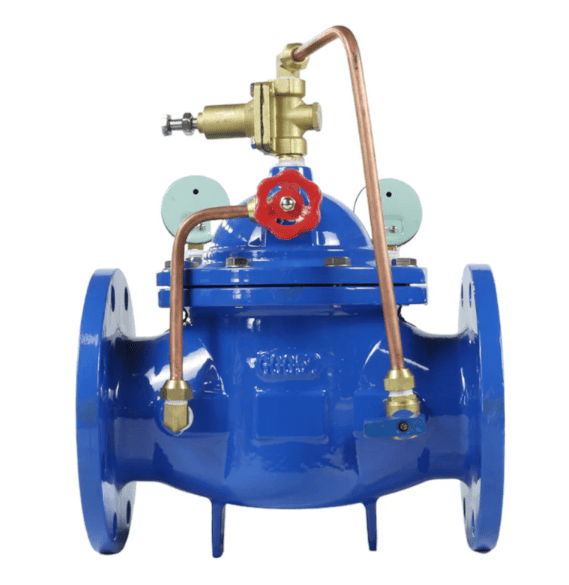
Pilot-operated pressure reducing valves are designed for larger flow rates and more demanding industrial applications. They incorporate a small pilot valve that controls the operation of a larger main valve.
Although they are larger in size and more complex than direct acting valves, they offer superior pressure stability and control in high-capacity systems.
Working Principle
A pilot-operated PRV uses:
- A pilot valve to sense downstream pressure
- A diaphragm chamber to amplify force
- A main valve for flow regulation
The pilot valve adjusts pressure in the diaphragm chamber. This amplified force controls the main valve opening, allowing precise pressure regulation even in high-flow systems.
Because the diaphragm area multiplies the force applied, pilot-operated valves can control much larger volumes of fluid with high accuracy.
Advantages
- Excellent pressure stability
- Suitable for large flow capacities
- Reduced pressure variation
- Better performance under fluctuating loads
- High precision regulation
Applications
Pilot-operated pressure reducing valves are commonly used in:
- Steam distribution systems
- Power plants
- Oil and gas facilities
- Petrochemical industries
- Large-scale water treatment plants
They are ideal for high-pressure, high-flow environments requiring precise control.
Understanding the internal components helps in proper selection and maintenance.
Typical components include:
- Valve body
- Diaphragm or piston
- Adjustment spring
- Seat and disc assembly
- Pilot valve (in pilot-operated designs)
- Control chamber
Each component contributes to maintaining stable downstream pressure while ensuring smooth operation.
Pressure reducing valves are used across numerous industries:
PRVs reduce boiler steam pressure for safe use in heating, sterilization, and processing applications.
They regulate natural gas pressure for industrial burners and commercial buildings.
PRVs protect plumbing systems by maintaining safe pressure levels.
Precise pressure control ensures safe reactions and protects equipment.
Maintains controlled steam and gas pressure for hygiene and product consistency.
Installing pressure reducing valves offers multiple advantages:
Enhanced Safety
Prevent overpressure situations that may cause system failure or accidents.
Equipment Protection
Extends the lifespan of downstream valves, pipes, and machinery.
Energy Efficiency
Optimizes steam and gas usage, reducing energy waste.
Improved Process Stability
Maintains consistent operating conditions for better product quality.
Reduced Maintenance Costs
Minimizes wear and tear caused by excessive pressure.
Proper maintenance is essential to ensure that pressure reducing valves (PRVs) continue to operate reliably and safely over their service life. Regular inspections and timely servicing not only prevent unexpected failures but also help maintain consistent pressure control, protecting downstream equipment and optimizing system performance.
The frequency of maintenance depends on the valve’s application, operating conditions, and manufacturer recommendations. As a general guideline:
- Quarterly visual inspections – Check for external signs of damage, leaks, or corrosion.
- Annual internal inspection and servicing – Examine internal components such as diaphragms, springs, and valve seats.
- High-stress environments – Systems exposed to high pressures, temperatures, or corrosive fluids may require more frequent inspections and maintenance.
During maintenance, focus on the following components:
- Diaphragm integrity – Look for cracks, tears, or material fatigue that could impair valve function.
- Spring condition – Ensure the adjustment spring retains its elasticity and has not deformed.
- Valve seat wear – Check for erosion or pitting that may cause leakage.
- Internal debris accumulation – Clean out any sediment or foreign particles that could obstruct flow.
Timely replacement of worn or damaged components ensures the PRV maintains optimal performance, minimizes downtime, and extends its operational life, safeguarding both system efficiency and safety.
Selecting the correct PRV requires careful evaluation of several factors.
Determine the required inlet and outlet pressures.
Calculate maximum and minimum flow demands.
Consider whether the medium is steam, gas, water, or corrosive liquid.
Ensure material compatibility with operating temperatures.
Evaluate space limitations, accessibility, and environmental exposure.
Choose designs that allow convenient servicing.
Consulting experienced valve specialists ensures proper sizing and performance.
Like all mechanical devices, PRVs may fail under certain conditions.
Fail Open or Fail Closed?
Pressure reducing valves can fail in either position depending on design and application.
Most industrial PRVs are designed to fail in a safe position — typically closed — to prevent downstream overpressure damage.
However, system designers must consider:
- Safety requirements
- Process criticality
- Redundancy systems
Proper risk assessment during system design minimizes potential hazards.
Some typical issues include:
- Pressure fluctuations
- Excessive noise
- Valve hunting (rapid cycling)
- Leakage
These problems may result from:
- Incorrect sizing
- Debris in the system
- Worn internal components
- Improper installation
Routine maintenance and correct valve selection prevent most operational issues.
Modern industrial systems are increasingly integrating smart technologies.
Emerging trends include:
- Digital pressure monitoring integration
- Remote diagnostics and predictive maintenance
- Advanced materials for corrosion resistance
- Improved diaphragm technologies
- Energy-efficient designs
Smart PRVs with monitoring capabilities are becoming more common in advanced industrial facilities.
Pressure reducing valves are critical components in modern fluid control systems, ensuring safe, stable, and efficient pressure regulation across various industries. Whether utilizing compact direct acting valves for small-scale applications or pilot-operated valves for high-flow industrial systems, selecting the appropriate PRV is essential for system performance and safety.
By understanding the different types, working principles, selection factors, and maintenance requirements, industries can optimize operational efficiency while minimizing risks and downtime.
As industrial processes continue to evolve, pressure reducing valves remain indispensable for protecting equipment, conserving energy, and ensuring safe fluid management in demanding environments.
