Forged steel check valves play a vital role in modern industrial piping systems, providing automatic protection against reverse flow and ensuring stable, safe operation across demanding fluid applications. Known for their strength, durability, and reliability under high temperature and high-pressure environments, forged steel check valves are widely used in oil and gas, petrochemical plants, power generation, refinery systems, and critical service applications requiring robust, leak-tight performance.
Unlike cast steel valves, forged valves are produced through a forging process that compresses and shapes heated steel into solid form. This manufacturing method refines the steel structure, enhances mechanical strength, reduces internal defects, and offers superior performance under stress. Because of these advantages, forged steel check valves are preferred for small-diameter, high-pressure piping systems where safety, longevity, and operational integrity are essential.
This industry news report provides a comprehensive examination of forged steel check valves—including structure, body-cover designs, operation principles, valve disc mechanisms, installation guidelines, types, selection criteria, performance considerations, and future industry trends—offering professionals a detailed reference for optimizing valve applications in industrial systems.
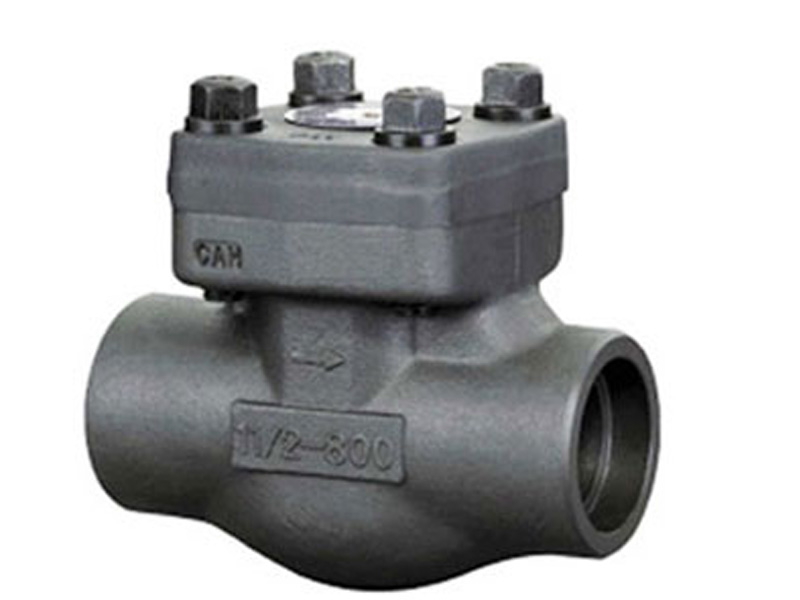
Forged steel check valves typically come in two primary body-cover configurations: bolted body cover and fully welded body cover. Each design has distinct operational characteristics and is selected based on pressure rating, service requirements, and maintenance needs.
The bolted body cover connection features a removable cover bolted to the valve body. A gasket is inserted between the body and cover to achieve a leak-free seal.
Advantages:
- Easier maintenance and internal inspection
- Convenient replacement of internal parts
- Service-friendly design for systems requiring periodic valve maintenance
This configuration is common in applications where regular valve servicing or part replacement is expected, such as in boiler systems, steam services, or pipeline systems with fluctuating flow conditions.
The fully welded design incorporates a welded joint between the valve body and cover, eliminating the need for bolts or gaskets.
Advantages:
- Permanent, leak-free sealing
- Enhanced structural integrity
- Reduced risk of fugitive emissions
- Suitable for high-pressure and high-temperature applications
- Zero maintenance on the body-cover joint
This design is frequently used in high-pressure, small-diameter pipelines where even minor leakage could lead to significant operational or safety risks. Fully welded forged steel check valves are ideal for steam systems, high-pressure chemical lines, and compact pipelines where space and maintenance access are limited.
The internal disc mechanism plays a central role in determining the valve's performance, flow characteristics, and suitability for specific conditions. Forged steel check valves are available in several disc configurations, each tailored for varying flow rates, pressures, and media.
Swing check valves utilize a disc-shaped plate attached to a hinge mechanism. As fluid flows forward, the disc swings open; when flow reverses, gravity and reverse pressure close the disc.
Characteristics:
- Best suited for stable or low-velocity flow
- Low pressure drop
- Quiet operation
- Common in oil, water, and low-pressure applications
Swing discs are widely used across standard industrial applications where smooth, unobstructed flow is required.
Lift check valves use a piston-like disc that moves vertically within a guide. Forward pressure lifts the disc to allow flow; reverse pressure pushes it down to close the valve.
Characteristics:
- Ideal for high-pressure applications
- Reliable in vertical upward flow and horizontal pipe configurations
- Suitable for steam, gas, and high-pressure water systems
Lift discs provide tighter sealing and higher performance in demanding environments compared to swing discs.
A needle-type disc involves a tapered needle that precisely regulates flow while preventing backflow.
Characteristics:
- Used for fine control of fluid flow
- Common in instrumentation and small-diameter pipelines
- Suitable for high-temperature and high-pressure fluids
These discs are typically incorporated in specialty check valves used in control systems.
Ball check valves employ a spherical ball that moves within the valve body. When forward flow pushes the ball away from the seat, fluid passes; when flow reverses, the ball returns to the seat to block backflow.
Characteristics:
- Compact design
- Suitable for small-diameter pipelines
- Effective with slurries or fluids containing particulates
- Self-cleaning seating surface
Ball check valves are commonly utilized in chemical processing lines, pumps, and reciprocating systems.
Proper installation is crucial for ensuring reliable performance, extending service life, and avoiding operational issues such as water hammer or incomplete closure. Industry guidelines emphasize the following considerations:
Different disc types require specific orientations:
- Swing check valves with vertical centerline hinges must be installed horizontally for proper disc movement.
- Lift check valves can be installed in horizontal or vertical upward flow pipelines.
- Ball check valves are often used in horizontal lines but may be installed vertically depending on design.
Ensuring correct orientation is essential to maintaining proper valve function.
All forged steel check valves must be installed with the arrow on the valve body pointing in the direction of forward flow. Incorrect installation can cause performance failure, excessive wear, or damage to the pipeline system.
Although forged steel check valves are compact, ample space should be provided around the valve for:
- Internal inspection
- Disc replacement
- Cleaning and debris removal
- Bolt tightening on bolted-body models
This ensures long-term serviceability and reduces maintenance downtime.
Water hammer occurs when fluid flow stops or reverses abruptly, creating pressure surges that can damage valves, pipes, and connected equipment.
To mitigate water hammer:
- Choose the appropriate disc type
- Consider fast-acting lift or ball check valves for high-velocity systems
- Use dual-plate or multi-disc swing check valves where needed
- Maintain proper installation slope and pipe support
Proper valve selection and installation are key factors in preventing costly operational disruptions.
In industrial applications, forged steel check valves are categorized based on disc movement, body design, and flow characteristics.
Swing check valves are preferred for large flow volumes and low resistance environments. They operate using a pivoted disc that swings open under forward flow and closes when flow stops or reverses.
Applications:
- Water distribution lines
- Oil pipelines
- Low-pressure steam systems
Their simple design and low-pressure drop make them versatile across many industries.
Piston check valves utilize a piston that slides within a cylinder to control flow based on pressure changes.
Advantages:
- Ideal for high-pressure pipelines
- Excellent sealing performance
- Minimal leakage
- Suitable for steam, condensate, and water hammer-prone applications
These designs are commonly used in power generation, petrochemical systems, and high-pressure process lines.
Ball check valves use a spherical ball as the closing element, providing fast closure and reliable operation.
Advantages:
- Compact, simple construction
- Suitable for viscous fluids or systems with particulate matter
- Minimal maintenance
- Effective in small-diameter pipelines
Ball check valves are widely used in chemical processing, pump discharge lines, and systems requiring compact valve solutions.
Selecting the correct forged steel check valve requires consideration of factors including fluid characteristics, pressure levels, pipe orientation, and service requirements.
Clean fluids → swing or lift check valves
Viscous or particulate fluids → ball check valves
High-temperature steam → piston or lift check valves
The medium's properties influence disc selection, wear rate, and sealing performance.
Forged steel check valves are designed to operate under high-pressure conditions. Ensure the valve's pressure class, typically Class 150 to Class 2500, aligns with system requirements.
Alignment with flow direction and disc movement is crucial:
Swing check valves → horizontal
Lift check valves → horizontal or vertical upflow
Ball check valves → flexible orientation
Improper installation can cause incomplete closure or premature wear.
If the system requires frequent internal inspection, a bolted body-cover design is preferred.
For permanent installations with no anticipated maintenance, fully welded models provide maximum reliability.
Common forged materials include:
- ASTM A105 (carbon steel)
- ASTM A182 F11/F22 (alloy steels for high temperature)
- ASTM A182 F304/F316 (stainless steel for corrosion resistance)
Material compatibility ensures optimal performance and extended valve life.
Forged steel check valves are essential in a wide range of industries due to their ability to withstand harsh environments and high-pressure conditions.
Used in:
- Crude oil processing
- Gas gathering systems
- High-pressure pipeline safety
- Pump discharge lines
Forged valves offer the durability needed in environments where pressure fluctuations and corrosive media are common.
Commonly used in:
- Boiler feedwater systems
- Steam lines
- Condensate return systems
- Turbine lubrication systems
Forged steel check valves handle high-temperature steam with excellent sealing reliability.
Applications include:
- Process fluid lines
- Cooling water systems
- Chemical feed systems
Corrosion-resistant materials are often used to ensure compatibility with aggressive chemicals.
Used in:
- Acidic or caustic media
- Reactor feed lines
- Pump discharge lines
- Applications requiring fast closure to prevent contamination
Ball and piston check valves are especially common in these systems.
Used in:
- Chilled water pipelines
- Heat transfer systems
- Pumping stations
- Condensate management
Forged valves ensure stable performance in both hot and cold service conditions.
The global market for forged steel check valves is projected to grow steadily as industries continue modernizing pipeline systems and replacing outdated valve technologies.
- Increasing demand for safe, high-pressure systems
- Expansion of power generation and refinery industries
- Growth in petrochemical production
- Emphasis on fugitive emission control
- Rising safety standards in industrial operations
Future innovations are expected to focus on:
- Enhanced anti-water-hammer design
- Optimized flow path engineering
- Automated monitoring integrations
- Extended service life through new alloys
- Environmentally friendly sealing technologies
Forged steel check valves play an indispensable role in protecting pipelines from reverse flow and ensuring safe, reliable fluid control across a wide range of industries. Their robust construction, multiple body-cover configurations, diverse disc options, and suitability for high-pressure environments make them essential components of modern industrial piping systems.
From swing, piston, and ball designs to bolted and fully welded body-cover configurations, forged steel check valves offer performance flexibility to meet the requirements of demanding applications. With ongoing advancements in metallurgy, manufacturing, and flow engineering, the industry will continue evolving toward more efficient, durable, and intelligent valve solutions.