In an era of ever-rising standards for operational safety and process integrity, the demand for valves that deliver not just reliable shut-off but verified isolation performance has grown sharply across oil & gas, petrochemical, power generation, and industrial process sectors. Double ball valves, engineered to provide two independent sealing barriers in one compact valve body, are emerging as a preferred choice in critical isolation applications where workplace safety, environmental compliance, and maintenance assurance cannot be compromised.
Unlike a standard single ball valve that offers one sealing surface between upstream and downstream, a double ball valve incorporates two ball mechanisms in series within the same enclosure. This design enables:
- Double block isolation — two physical barriers preventing product migration
- Bleed or vent capability — a center cavity bleed port between the balls
- Verification of seal integrity — confirmed via cavity vent testing
These features collectively deliver what the industry refers to as the Double Block and Bleed (DBB) functionality, an increasingly specified requirement in international engineering standards and project specifications.
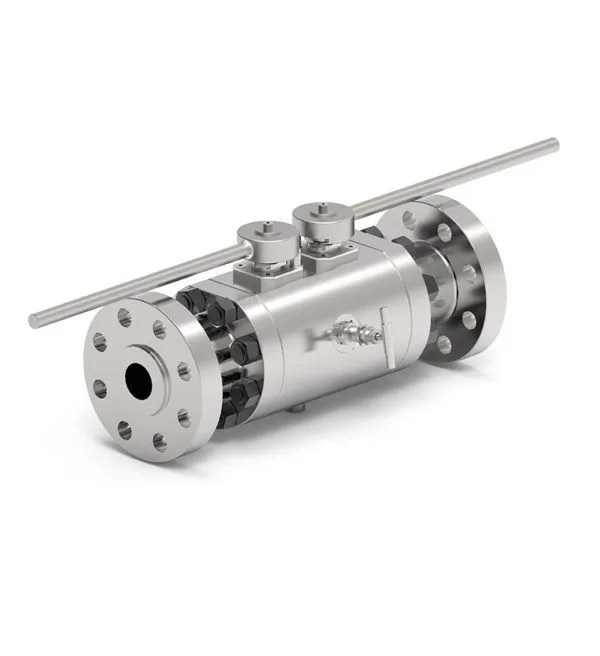
At its core, a double ball valve consists of:
- Two ball valves installed sequentially in a single, integrated valve body
- A center cavity between the ball closures
- A bleed port or vent that leads from the center cavity to a safe draining or testing point
When both balls are closed, the center cavity becomes isolated from both upstream and downstream lines. Opening the bleed port allows operators to release or monitor pressure in the valve cavity — confirming that both seals are intact with no leakage past either ball.
This structural redundancy — two independent seals instead of one — enables:
- Enhanced safety for maintenance activities
- Confident leak prevention
- Verification of sealing performance without exposing personnel or adjacent systems to live fluids
The double block and bleed design is also often combined with other safety features such as:
- Anti-static devices
- Fire-safe designs
- Blow-out proof stems
- Pressure-balanced seats
- Soft or metal seated options
The result is a valve that offers mechanical integrity well beyond what single isolation valves can provide.
Understanding the operation of double ball valves begins with recognizing the importance of the valve's center cavity — the space between the two ball elements.
When the process fluid travels through the pipeline under normal operation and the valve is in the open position, both balls are rotated by the actuator or handle to allow unrestricted flow, just like a conventional ball valve. In this position:
- No blocking function is active
- Flow is permitted
- The center cavity is not pressurized
To isolate the downstream process:
- The upstream ball valve is closed first
- The downstream ball valve closes second
- The center cavity is now trapped between two closed balls
At this point, the center bleed port can be opened to safely drain or vent the cavity. If pressure is detected during this step, it indicates leakage past one or both seats — a critical diagnostic insight not available on single-ball designs.
This simple yet powerful sequence enables "verified isolation," meaning the end-user knows that both balls are sealing properly before proceeding with maintenance or adjacent activities.
In some double ball valves designed without an equalization hole, the isolation and bleed procedure can be performed even when the balls are in the open position (not just when closed). This variant is referred to as Fully Double Block and Bleed (FDBB).
With FDBB valves:
- Both isolation seals can be confirmed at any operating position
- The system provides maximum assurance of seal correctness
- Downstream pressure can be reduced to zero without interrupting upstream process conditions
One of the strongest advantages of double ball valves is the ability to verify seat integrity in real-time. Unlike single isolation valves, which can only assume the seal is effective, DBB valves enable operators to confirm that each seat is successfully blocking pressure before proceeding.
This characteristic is especially critical in:
- Blowdown systems
- Hydrocarbon isolation
- Chemical injection skids
- Sampling manifolds
- Metering and analyzer protection
Verified isolation increases worker safety during maintenance and reduces the risk of downstream contamination or leakage.
A double ball valve provides two physical seals in series — not just a secondary relief or control path. This structural redundancy greatly reduces the risk of a single point of failure. Even if one seat leaks, the second acts as a backup barrier.
Double barriers are particularly required in:
- Hazardous chemical transfer lines
- High pressure and high temperature hydrocarbon lines
- Systems handling toxic, flammable or dangerous media
Engineers specify DBB valves in applications where a single isolation valve does not provide adequate assurance — especially when leakage consequences are severe.
The center cavity bleed port is more than a safety vent — it serves as a channel for:
- Pressure verification
- Fluid drainage
- Flushing or purging the cavity
- Leak detection
By venting the trapped cavity fluid to a safe point, technicians can confirm that the cavity pressure is zero — meaning there's no leak past either seal.
In practice, this reduces:
- Occupational hazards
- Environmental risk
- Unexpected system pressurization
- Potential for costly process upsets
In many installations, pumps, compressors, and sensitive instruments need reliable isolation both upstream and downstream. With double ball valves, operators can:
- Shut off flow from both sides
- Ensure no backflow during shutdowns
- Avoid pressure surges during restart
- Protect downstream equipment during maintenance
This dual protection contributes to:
- Longer equipment life
- Reduced maintenance costs
- Higher uptime
Because double ball valves combine two isolation elements into a single assembly, they often replace:
- Two separate ball valves
- A block valve with an additional bleed valve
This consolidation yields:
- Lower overall valve count
- Simplified piping layouts
- Reduced potential leak points
- Cost savings in fabrication and installation
Particularly in modular skids or tight spaces, compact DBB configurations are appreciated for their space efficiency.
Double ball valves are not one-size-fits-all — they are engineered with multiple configurations to suit specific service conditions.
Floating double ball valves have balls that are supported by the seats and rely on seat compression for sealing. They are ideal for mid-pressure applications.
Trunnion-mounted double ball valves have balls anchored by internal shafts supporting top and bottom loads — suitable for high pressure and larger diameters.
Both styles can be implemented with DBB capability.
Soft seat valves use polymeric sealing rings (e.g., PTFE, RPTFE) for tight shut-off and low torque. They are common in low-temperature, non-abrasive service.
Metal seat valves provide superior performance in high temperatures, abrasive environments, and where soft materials cannot withstand process conditions.
Both variants can adopt double sealing arrangements and cavity bleed systems.
Modern operations increasingly prefer automation. Double ball valves are available with:
- Manual gear operators
- Pneumatic actuators
- Electric actuators
- Hydraulic actuation
- Smart positioners and feedback systems
Actuated DBB valves enable remote operation — crucial for hazardous or hard-to-access installations.
Double ball valves are subject to rigorous standards depending on application and industry. Some of the governing specifications include:
- API 6D / API 6A — standards governing ball valves used in pipeline and wellhead applications
- API RP 584 — recommended practice for DBB valves in pipeline pigging systems
- ISO 14313 — petroleum and natural gas industries requirements
- ANSI/ASME B16.34 — valve design, pressure-temperature ratings, materials
In many critical projects, engineering specifications explicitly call for DBB valves with stringent performance testing before commissioning.
Sampling stations demand impeccable isolation to prevent cross-contamination and inaccurate data. Double ball valves:
- Enable true isolation before maintenance
- Prevent fluid migration to analyzers
- Reduce downtime and sampling errors
Metering equipment requires:
- Stable flow conditions
- Isolation that can be verified before instrument maintenance
DBB valves guarantee that entire metering trains can be taken offline safely.
In upstream and downstream hydrocarbon environments, regulations often require double isolation before human interaction. DBB valves:
- Protect workers from explosive gas exposure
- Prevent downstream leaks
- Satisfy regulatory safety checks
Handling hazardous reagents necessitates tight isolation. Double ball valves reduce:
- Risk of toxic leaks
- Environmental exposure
- Emergency shutdown consequences
Boiler blowdown, steam lines, and feedwater isolation benefit from the enhanced sealing provided by double ball valves — especially under high temperature and pressure.
The adoption of double ball valves brings measurable improvements in safety, maintenance procedures, and operational reliability:
Enhanced Maintenance Safety
Operators can confidently verify that both barriers are functioning before performing maintenance on downstream equipment.
Reduced Risk of Process Leaks
Double sealing mechanisms dramatically lower the risk of leaks into pipelines, pits, or atmospheric vents — reducing environmental and safety liabilities.
Fewer Unplanned Shutdowns
By allowing cavity tests without process interruption, DBB valves support preventive maintenance strategies.
Regulatory Compliance
Many jurisdictions now require documented isolation verification for critical operations. Double ball valves support compliance with real-time confirmation.
The global valve market has seen significant growth in double ball valve adoption due to:
- Increasing safety regulations in oil & gas and petrochemical sectors
- Higher demand for reliable isolation in renewable energy applications
- Growth of automated valve control systems
- Rising requirement for certified valves in critical infrastructures
Manufacturers report increased orders of DBB designs especially in Europe, North America, and the Middle East where safety standards are most stringent. Industry associations and project specifications are also progressively mandating DBB valves in hazardous fluid handling and high-pressure pipelines.
For engineers and end-users specifying double ball valves, best practice recommendations include:
Match seat materials (soft or metal) to service temperature, media chemistry, and operational cycles.
Ensure cavity bleed lines are routed to safe venting or collection points and labeled clearly for operators.
When operating remotely or under hazardous conditions, automated actuation improves safety and control.
Install pressure gauges or sensors on cavity ports to allow real-time verification.
Select valves tested or certified according to applicable codes (API, ISO, ANSI).
Today's operational environments demand not just isolation — they demand verified isolation. Double ball valves deliver a level of functional assurance that traditional single ball valves cannot match. By providing two independent sealing barriers, an accessible center bleed port, and the ability to verify seal integrity without process interruption, DBB valves stand at the forefront of modern process safety engineering.
Whether in oil & gas, chemical processing, power generation, or any industry where pressure retention and leak prevention are critical, double ball valves are rapidly becoming a standard specification — not just a preferred option.
Their combination of improved safety, reduced maintenance risk, regulatory support, and operational reliability positions them as a key technology in 21st-century valve engineering.