
In the global industrial valve market, demand for reliable, standardized, and high-performance flow control equipment continues to grow as infrastructure expands across energy, water, petrochemical, and manufacturing sectors. Among the wide range of valve technologies available today, the DIN Gate Valve stands out as one of the most essential and widely adopted solutions for pipeline isolation applications.
Designed in accordance with German Industrial Standards (DIN), the DIN gate valve is engineered to meet strict requirements for dimensional accuracy, pressure ratings, material integrity, and operational safety. Its primary function is simple yet critical: to provide full open or full shut-off control of fluid flow in pipelines. Unlike control valves that regulate flow, gate valves are designed for isolation, ensuring minimal leakage and maximum flow efficiency when fully open.
As global industries continue to demand safer, more efficient, and longer-lasting pipeline components, DIN gate valves have become a preferred choice due to their robust design, compatibility with international systems, and proven reliability in extreme working conditions.
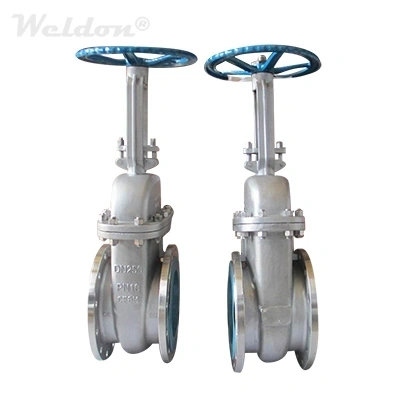
A DIN Gate Valve is a linear-motion valve that uses a wedge-shaped gate to control the flow of liquids, gases, or steam in a pipeline system. It is manufactured in accordance with DIN standards, which ensure consistency in design and interchangeability across international installations.
The valve operates by lifting or lowering a gate (disc) perpendicular to the flow direction. When the gate is fully raised, the flow passage becomes completely unobstructed, resulting in very low pressure drop. When fully lowered, the gate tightly seals against the valve seats, effectively stopping the flow.
Key structural elements include:
- Valve body (cast or forged steel)
- Rising or non-rising stem
- Wedge-shaped gate disc
- Seat rings (metal or resilient sealing)
- Bolted bonnet for maintenance access
- DIN-standard flanged end connections
The simplicity of its design combined with strong sealing capability makes it highly suitable for critical industrial systems where operational reliability is essential.
The operating mechanism of a DIN gate valve is based on linear motion driven by a handwheel, gearbox, or automated actuator.
When the handwheel is rotated clockwise or counterclockwise:
- The stem converts rotational motion into linear movement.
- The gate moves vertically inside the valve body.
- In the open position, the gate is fully lifted, allowing unrestricted flow.
- In the closed position, the gate is fully lowered, pressing tightly against the seat to block flow.
Because the gate moves perpendicular to the flow direction, the valve offers minimal resistance when fully open, making it highly efficient for long-distance pipeline systems.
The rising stem design also provides a clear visual indication of valve position, which is especially valuable in large-scale industrial environments where operational safety and quick status recognition are important.
DIN gate valves are designed with a focus on durability, sealing integrity, and long-term operational stability. Their engineering structure is optimized for high-pressure and high-temperature environments.
The valve body is typically manufactured using high-strength materials such as:
- Cast carbon steel
- Stainless steel
- Alloy steel
- Duplex stainless steel
These materials ensure resistance to pressure fluctuations, corrosion, and mechanical stress.
The wedge-shaped gate provides a tight mechanical seal when closed. Depending on application requirements, manufacturers may use:
- Solid wedge design
- Flexible wedge design
- Split wedge configuration
Each design offers different advantages in terms of sealing performance and thermal expansion compensation.
The sealing surfaces between the gate and seat are precisely machined to ensure leak-free operation, even under high-pressure conditions.
Standardized flanges ensure compatibility with European and international pipeline systems, simplifying installation and replacement.
DIN gate valves are widely used in industries where reliable isolation and minimal pressure loss are critical. Their versatility allows them to handle a wide range of media, including water, steam, oil, gas, and chemical fluids.
In upstream and downstream operations, DIN gate valves are essential for:
- Crude oil transmission pipelines
- Natural gas distribution systems
- Refinery processing units
- Storage and transportation terminals
Their ability to maintain tight sealing under extreme pressure and temperature conditions ensures operational safety and system integrity.
In thermal, hydro, and nuclear power plants, DIN gate valves are used in:
- Boiler feedwater systems
- Steam distribution lines
- Cooling water circuits
- Thermal oil pipelines
Their metal-to-metal sealing capability and resistance to high temperatures make them suitable for continuous, high-load operation.
Municipal and industrial water systems rely on DIN gate valves for:
- Clean water distribution networks
- Pumping stations
- Sewage and wastewater treatment plants
- Irrigation systems
Their low pressure loss and corrosion-resistant material options ensure long service life and efficient water management.
In chemical processing environments, DIN gate valves are used to handle:
- Acidic and alkaline fluids
- Corrosive chemical compounds
- Industrial solvents and reagents
Special material selections such as stainless steel or lined valves help prevent corrosion and ensure safe operation.
DIN gate valves offer a combination of mechanical simplicity and high-performance characteristics that make them indispensable in modern pipeline engineering.
When fully open, the valve allows unobstructed flow, resulting in extremely low pressure loss and high energy efficiency.
The wedge design ensures tight shut-off, minimizing leakage risks in critical applications.
The straight-through design reduces turbulence and energy consumption in pipeline systems.
Suitable for demanding environments, including steam and high-temperature fluids.
Durable materials and precision manufacturing ensure extended operational lifespan.
Bolted bonnet design allows easy access for internal inspection and repair.
The performance and durability of DIN gate valves depend heavily on material selection and manufacturing precision.
Common materials include:
- Carbon steel (WCB) – general industrial applications
- Stainless steel (CF8, CF8M) – corrosion-resistant environments
- Alloy steel (WC6, WC9) – high-temperature service
- Duplex stainless steel – chemical and offshore applications
Advanced manufacturing processes include:
- Precision casting and forging
- CNC machining for dimensional accuracy
- Heat treatment for mechanical strength
- Surface finishing for sealing performance
Sealing components may include:
- Metal seats for high-temperature service
- PTFE or graphite gaskets for chemical resistance
- Hard-faced sealing surfaces for abrasion resistance
Proper installation is essential to ensure long-term reliability and performance.
Ensure the pipeline is fully depressurized and isolated before installation begins.
Check valve body, flanges, and sealing surfaces for damage or contamination.
Carefully align the valve with pipeline flanges to avoid mechanical stress.
Tighten flange bolts evenly in a cross-pattern to ensure uniform sealing pressure.
After installation, slowly operate the valve through full open and close cycles to verify smooth movement and leak-free performance.
Although DIN gate valves are designed for durability, regular maintenance ensures consistent performance.
Recommended practices include:
- Periodic lubrication of stem threads
- Inspection of sealing surfaces for wear
- Monitoring for corrosion or deposits
- Checking actuator or gearbox performance
- Ensuring proper alignment of valve components
Preventive maintenance significantly reduces the risk of unexpected failures and extends the service life of the valve.
The global valve industry is undergoing rapid transformation, and DIN gate valves are evolving to meet modern industrial demands.
Integration with electric, pneumatic, and hydraulic actuators enables remote operation and process automation.
Modern systems include sensors for:
- Valve position tracking
- Pressure and temperature monitoring
- Predictive maintenance alerts
New alloys and coatings improve resistance to corrosion, erosion, and thermal stress.
Improved internal designs reduce friction and enhance flow efficiency, lowering operational energy consumption.
Smart factories are adopting digital valve management systems for real-time data analysis and system optimization.
The demand for DIN gate valves continues to grow steadily due to:
- Expansion of oil and gas infrastructure
- Increasing water treatment investments
- Growth in power generation capacity
- Industrial automation trends
Europe, Asia-Pacific, and the Middle East remain key markets, while emerging economies are investing heavily in pipeline modernization projects.
The DIN Gate Valve remains a fundamental and indispensable component in global pipeline systems. Its standardized design, reliable sealing performance, and ability to operate under high-pressure and high-temperature conditions make it essential for industries ranging from energy and petrochemicals to water treatment and power generation.
As industrial systems continue to advance toward smarter, more automated, and more efficient operations, DIN gate valves are also evolving with improved materials, digital integration, and enhanced engineering precision. Their role in ensuring safe, efficient, and stable fluid control will remain critical in supporting the development of modern industrial infrastructure worldwide.
