Fully welded ball valves have become a critical component in modern underground pipeline systems where reliability, sealing integrity, and long service life are essential. In buried or hard-to-access pipeline environments, traditional valve structures often struggle with leakage risks, flange corrosion, and maintenance difficulties. Fully welded ball valves address these challenges by eliminating body joints and adopting a one-piece welded construction that significantly improves structural integrity.
In industries such as natural gas transmission, district heating, petroleum distribution, chemical processing, and water supply infrastructure, underground pipelines operate under continuous pressure, temperature variation, and soil-induced external loads. Under these demanding conditions, valve performance directly affects system safety and operational stability.
Unlike conventional bolted-body valves, fully welded ball valves are designed with a hermetically sealed body structure. This eliminates potential leakage paths from gaskets or flange connections and ensures long-term stability even when the valve is buried for decades. Their corrosion resistance, pressure-bearing capability, and maintenance-free characteristics make them especially suitable for underground and remote pipeline installations.
As infrastructure projects expand globally, selecting a reliable fully welded ball valve manufacturer becomes a strategic decision rather than a simple procurement choice. The quality of materials, welding technology, pressure testing standards, and anti-corrosion treatment directly determine long-term pipeline safety and operational cost efficiency.
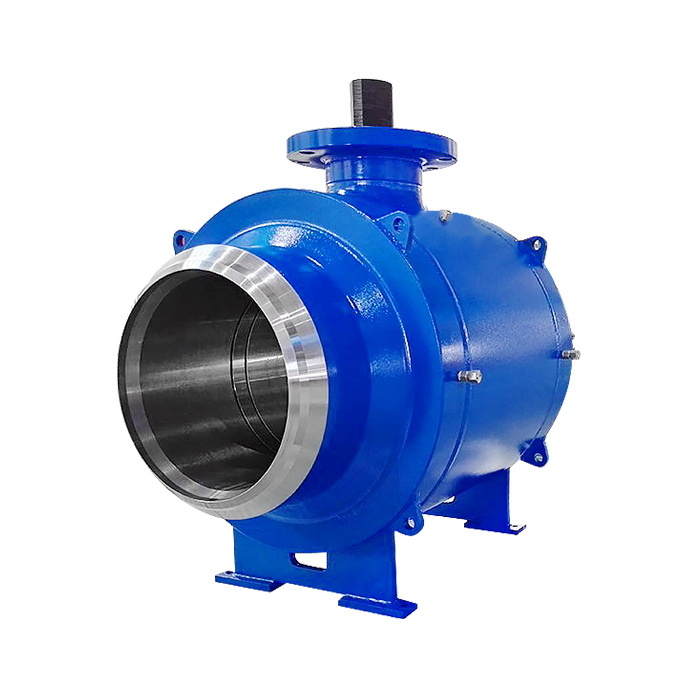
The operating principle of a fully welded ball valve is based on a simple yet highly efficient quarter-turn mechanism. At the core of the valve is a spherical ball with a central bore (also called a flow passage). This ball is connected to a stem that is controlled manually, through a gearbox, or by an automated actuator.
When the stem rotates the ball by 90 degrees, the valve transitions between open and closed states:
- In the open position, the bore of the ball aligns with the pipeline, allowing fluid, gas, or slurry to flow freely with minimal resistance.
- In the closed position, the solid surface of the ball faces the pipeline, completely blocking flow and ensuring tight shutoff.
What distinguishes a fully welded ball valve from other types is its body construction. Instead of being assembled using flanges or bolts, the valve body is permanently welded into a single sealed unit. This structure eliminates external leakage paths and reduces mechanical failure risks caused by gasket aging or bolt loosening.
Because the internal components are fully enclosed, the valve provides excellent resistance against external environmental factors such as soil moisture, chemical corrosion, and mechanical stress from ground movement. This makes it particularly suitable for underground installation where maintenance access is limited or extremely costly.
The combination of a simple operating mechanism and a robust welded structure results in a valve that offers both high reliability and long service life in demanding industrial applications.
Fully welded ball valves are engineered to deliver superior performance in underground pipeline systems. Their structural design offers several advantages compared to traditional valve types.
The most important feature is the elimination of flange connections. Since the valve body is fully welded, there are no gasketed joints that can degrade over time. This significantly reduces the risk of leakage, especially in high-pressure or hazardous fluid systems.
The welded body forms a unified pressure shell that distributes stress evenly across the valve structure. This allows the valve to withstand high internal pressures and external soil loads without deformation or failure.
Underground environments expose valves to moisture, chemicals, and soil acidity. Fully welded ball valves are often coated with anti-corrosion layers such as epoxy, polyethylene, or fusion-bonded coatings, ensuring long-term resistance to external corrosion.
Because they are typically installed underground, fully welded ball valves are designed to operate for decades without routine maintenance. Their sealed construction eliminates the need for periodic gasket replacement or flange tightening.
The combination of welded sealing, high-quality materials, and protective coatings significantly extends the operational lifespan of the valve, often matching or exceeding the life of the pipeline itself.
Proper installation is essential to ensure the long-term performance of fully welded ball valves. Because these valves are permanently integrated into pipeline systems through welding, installation must follow strict procedures and engineering standards.
Orientation
Correct positioning is the first step in installation. The valve must be aligned according to the pipeline flow direction. Most valves include a flow arrow on the body indicating the correct orientation. Ensuring correct alignment prevents operational inefficiency and reduces wear on internal sealing components.
Alignment
Precise alignment between the valve and pipeline is essential before welding. Misalignment can create stress points in the pipeline system and affect weld quality. Alignment tools or pins are commonly used to ensure that flange or pipe ends are perfectly centered.
Spacing
Adequate spacing must be maintained between the valve and adjacent pipeline components. This allows sufficient room for welding equipment, thermal expansion, and future inspection if required. Installation guidelines provided by manufacturers should always be followed.
Welding is the most critical stage in installing a fully welded ball valve because it determines the long-term sealing integrity of the system.
Welding Procedure Development
A detailed welding procedure specification (WPS) must be prepared based on the pipeline material, valve material, and applicable welding standards. The procedure defines welding methods, filler materials, temperature control, and inspection requirements.
Surface Preparation
Before welding begins, all contact surfaces must be thoroughly cleaned. Dirt, grease, oxidation layers, and rust must be removed using mechanical tools such as wire brushes or grinding machines. Proper surface preparation ensures strong metallurgical bonding.
Welding Execution
Depending on pipeline requirements, different welding methods may be used, including:
- Shielded Metal Arc Welding (SMAW)
- Gas Tungsten Arc Welding (GTAW)
- Gas Metal Arc Welding (GMAW)
Qualified welders must carry out the operation according to approved procedures. Controlled heat input is essential to prevent deformation of the valve body and maintain internal alignment.
Weld Quality Control
After welding, joints must be inspected for cracks, porosity, or incomplete fusion. Non-destructive testing methods such as ultrasonic testing or radiographic inspection are often applied to ensure weld integrity.
After installation, a series of tests must be conducted to verify the safety and functionality of the valve and pipeline system.
Pressure Testing
Pressure testing is performed to confirm that the system can withstand operational conditions without leakage. A test pump is used to gradually increase pressure inside the pipeline while monitoring for any drop in pressure or visible leakage.
This step is essential for validating both the valve body and weld joints.
Functional Testing
Functional testing ensures that the valve operates smoothly. The valve is opened and closed multiple times to verify torque consistency, sealing performance, and mechanical responsiveness. Any abnormal noise or resistance must be investigated before commissioning.
Inspection and Non-Destructive Testing
Advanced inspection techniques are used to ensure structural integrity. Ultrasonic testing detects internal flaws, while radiographic testing provides imaging of weld quality. These methods help confirm that no hidden defects exist within the welded structure.
Fully welded ball valves are widely used in industries where safety and reliability are critical. Their primary applications include:
Natural Gas Transmission
They are extensively used in underground gas pipelines where leakage prevention is a top priority.
Oil Pipelines
Their high pressure resistance makes them suitable for crude oil and refined product transportation systems.
District Heating Networks
They help regulate hot water and steam flow in underground heating systems, ensuring energy efficiency and safety.
Chemical Processing
Their corrosion-resistant structure allows them to handle aggressive chemicals in buried pipelines.
Water Supply Systems
Municipal water distribution networks use fully welded valves to reduce maintenance requirements and improve system reliability.
One of the major advantages of fully welded ball valves is their minimal maintenance requirement. Since the valve body is sealed and buried underground, routine inspection is limited to external pipeline monitoring.
Key lifecycle benefits include:
- Reduced maintenance costs
- Lower risk of operational downtime
- Extended service intervals
- Improved system reliability
In many cases, these valves operate maintenance-free for decades, making them highly cost-effective over their lifecycle.
Fully welded ball valves represent a significant advancement in underground pipeline technology. Their welded one-piece structure eliminates traditional leakage risks, enhances pressure resistance, and ensures long-term reliability in harsh environments.
From natural gas and petroleum pipelines to district heating and water supply systems, these valves play a vital role in maintaining infrastructure safety and efficiency. Their installation requires precise welding procedures, careful alignment, and strict testing protocols, but once installed correctly, they offer decades of stable performance with minimal maintenance requirements.
As global infrastructure continues to expand and underground pipeline systems become more complex, fully welded ball valves will remain an essential solution for engineers seeking durability, safety, and operational efficiency in critical fluid control applications.